
Alberto Privitera
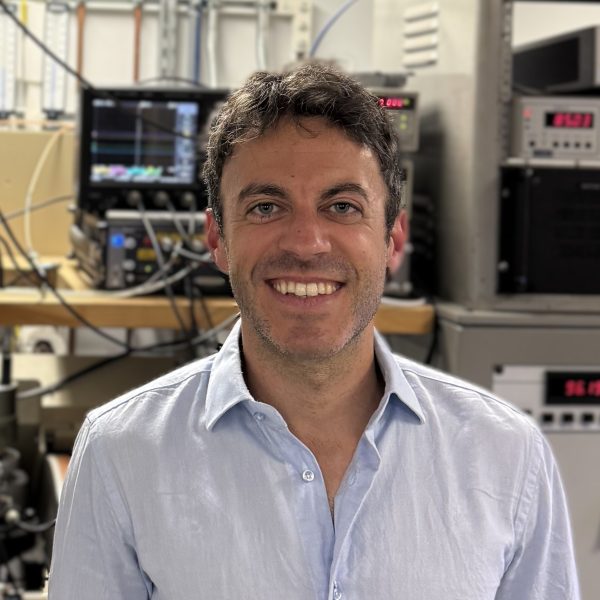
Alberto Privitera has applied EPR to investigate the photophysics of diverse systems, including organic molecules, photovoltaic thin-film materials, and molecular qubit systems. His latest achievements include experiments to detect chirality-induced spin selectivity (CISS) in donor-acceptor compounds containing a chiral donor using time-resolved EPR and work on room-temperature optical spin polarization in a vanadyl spin qubit. These studies open new pathways for understanding spin-polarization mechanisms in chirality and transition-metal-based qubits. Alberto has made great progress on two directions. First, he investigated a trimeric porphyrin in which the photoexcited central free-base porphyrin serves as a controllable coupler to spin couple the two vanadyl qubits of the outboard porphyrins. This technique may result in a method to entangle two spins using the agency of the triplet excited state of a porphyrin. Second, Alberto contributed to research on the photogeneration of strongly spin-coupled radical pairs separated by a chiral bridge molecule. In this case, the molecules are designed to eliminate radical pair intersystem crossing leaving only CISS to produce triplet character in the radical pair. This work will have a significant impact on understanding the CISS mechanism. Alberto has established himself as an emerging leader in light-induced EPR spectroscopies and their application to key fields such as renewable energy and quantum information science.
